
Pricing Used Inventory: Know What It’s Worth Before You Name a Number
Pricing used inventory is a margin problem hiding inside a workflow problem. The person naming the price usually has seconds, not an hour, to decide what an item is worth. If they price too low, margin disappears. If they price too high, the item sits or the deal falls apart.
The business question is simple: what should we offer or list this item for, based on the market right now?
The data used
The demo uses used bicycles because the market is active, fragmented, and easy to verify. For each pricing request, the workflow pulls current eBay comparables and extracts the relevant listing details. The important inputs are the same things a human pricer would check manually:
- Make, model, year, and condition
- Recent comparable prices
- Location and market context
- Evidence strength: how many close matches were available, and how consistent they were
The workflow
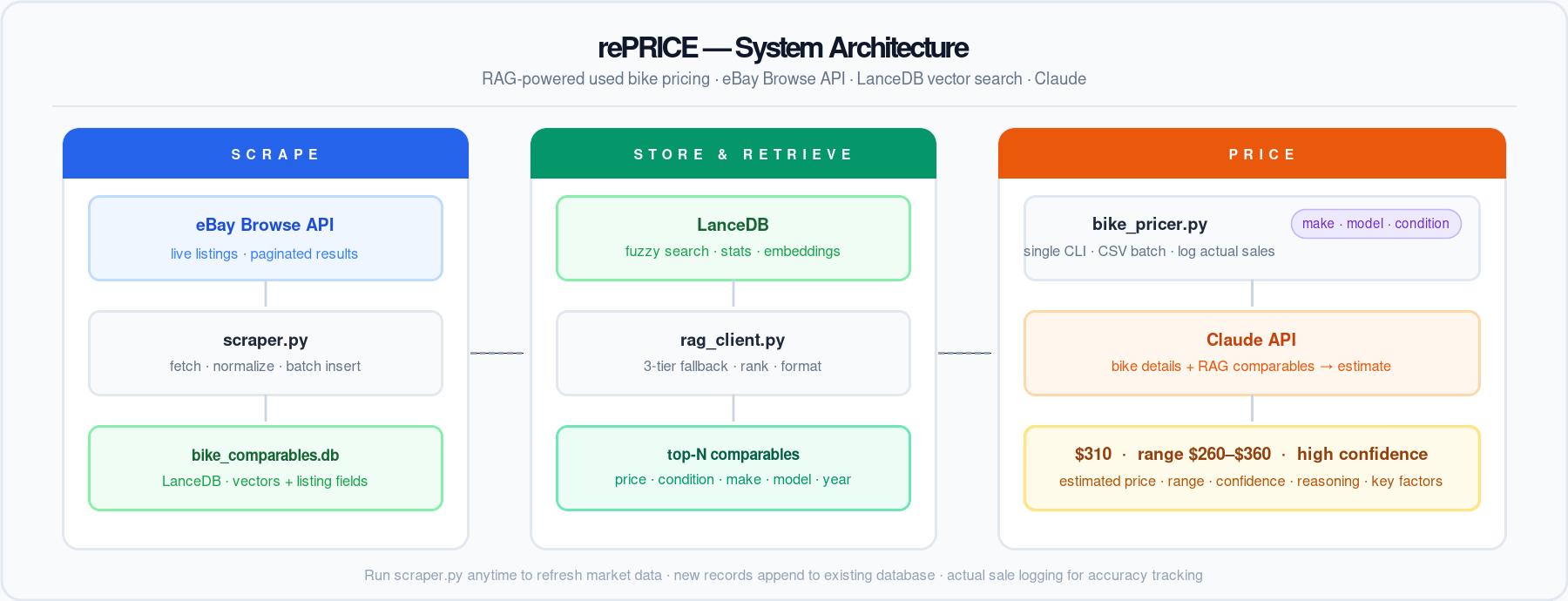
You provide a make, model, year, and condition. The workflow retrieves the closest real-world comparables, computes market statistics, and produces a pricing card in under a second:
====================================================
  Trek FX 3  [good]
====================================================
  Estimated price : $310
  Price range     : $260 – $360
  Confidence      : high
  Reasoning       : Strong comparable sales in Seattle market with recent
                    2021 models selling at this range.
  Key factors     :
    - Aluminum frame holds value well
    - Minor cosmetic wear typical for good condition
    - Active Seattle commuter bike demand
That estimate is grounded in the same listings a buyer would find if they searched eBay themselves. The difference is that the evidence is gathered, filtered, and summarized in a repeatable way.
The decision it enables
The output is not a dashboard. It is a decision aid for the moment when a price has to be named:
- What should we offer for this item?
- What should we list it for?
- How wide should the acceptable price range be?
- Is the evidence strong enough to trust, or should a human review it?
For an operator, the value is consistency. The same pricing logic can run for every employee, every location, and every week without relying on one person’s memory of the market.
Who should care
Used bikes are a convenient example, but the problem is universal. A pawn shop deciding what to offer on a guitar before the customer walks out. A used furniture dealer sizing up an estate purchase without time to run a full market sweep. A consignment shop trying to move inventory without leaving margin behind. A clinic or care-adjacent business pricing refurbished equipment, resale inventory, or patient-facing supply bundles where market prices move faster than the internal reference sheet.
Anywhere you price assets in a changing market, the cost of being wrong adds up quickly. The decision-support pattern is the same: ground the estimate in current data, make the reasoning visible, and turn the process into a repeatable workflow.
How it works
The workflow pulls live listings for whatever item is being valued, stores them in a searchable database, and retrieves the closest matches by make, model, condition, and geography. It then summarizes comparable listings into a price range with visible reasoning. If the database does not have an exact match, it widens the search until there is enough evidence to work with.
If pricing discipline is eating margin in your operation, start with a free Operations Audit